
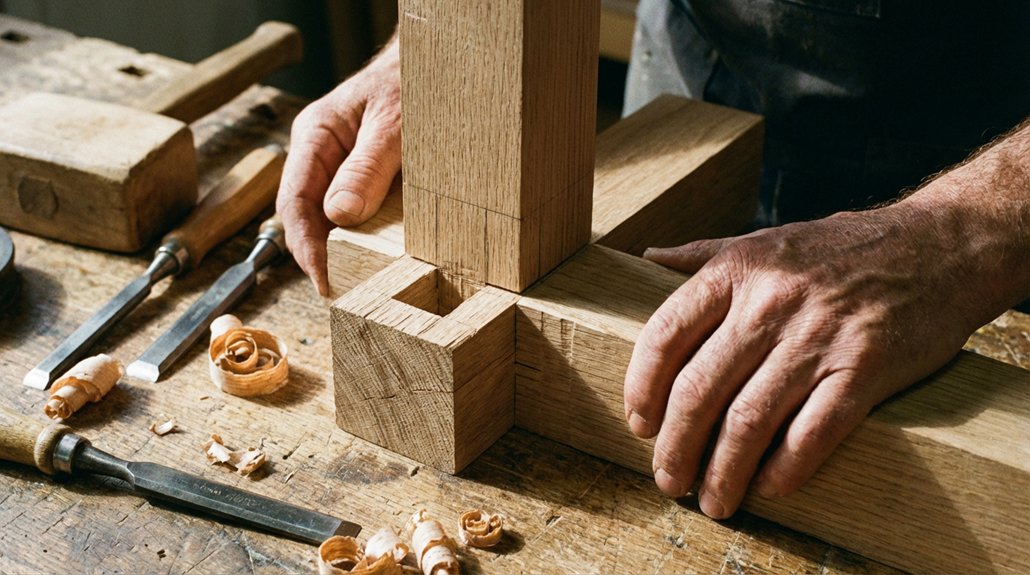
Ancient joinery techniques, such as mortise-and-tenon and dovetail joints, ensure solid wood furniture lasts for centuries. These techniques distribute mechanical stress across broad surface areas, avoiding reliance on adhesives or fasteners. For example, a properly fitted mortise-and-tenon joint can support over 1,000 pounds, making it ideal for heavy-duty applications. Dovetail joints resist pulling forces thanks to their interlocking wedge design.
Precise grain alignment and snug fits in these joints prevent lateral movement, which significantly reduces the risk of failure over time. These methods create durable connections that stand up to daily wear and tear. As you delve deeper into these techniques, you’ll see how they consistently outperform modern methods.
Mortise-and-Tenon Joints Provide Strength
Mortise-and-tenon joints deliver exceptional strength and stability for furniture. The mortise, a cavity cut into one piece of wood, accepts the tenon, a projection from another piece. When fitted correctly, this joint locks together securely, distributing weight evenly. This structure allows furniture to carry heavy loads without compromising integrity.
Dovetail Joints Offer Resistance
Dovetail joints excel in resisting pulling forces. The design features interlocking wedges that create a mechanical bond, preventing separation. These joints are often used in drawer construction, where lateral movement can occur. Their resistance to pulling forces ensures drawers maintain alignment and function smoothly over time.
Precision and Fit Reduce Movement
Precision in grain alignment and the snug fit of joints are crucial in maintaining furniture stability. When wood pieces fit together tightly, lateral movement is minimized. This precision reduces wear on joints, leading to longer-lasting furniture. Regular inspection and maintenance can help preserve these joints, ensuring they remain tight and functional.
Limitations of Modern Methods
Modern adhesives and fasteners can weaken over time, especially when exposed to moisture or temperature changes. Unlike ancient techniques, these methods often fail under stress, leading to furniture deterioration. Understanding these limitations emphasizes the value of traditional joinery techniques in creating lasting furniture.
Conclusion on Ancient Joinery Techniques
In conclusion, ancient joinery techniques like mortise-and-tenon and dovetail joints provide unmatched durability in solid wood furniture. Their ability to distribute stress, resist pulling forces, and maintain stability makes them superior to modern methods. Employing these techniques ensures that furniture not only survives but thrives for generations.
Why Mass-Produced Furniture Fails Where Handmade Solid Wood Holds?
When you purchase mass-produced furniture, you receive a product designed primarily for speed and low cost. Manufacturers often use materials like particleboard, MDF, and inexpensive adhesives to reduce expenses.
These materials deteriorate quickly under daily use, moisture, and weight. As a result, you can expect warping, splitting, and weakened joints within just a few years of use.
Cheap materials break down fast — expect warping, splitting, and failing joints within just a few years of daily use.
In contrast, handmade solid wood furniture leverages high-quality materials and traditional craftsmanship. Skilled artisans use techniques passed down through generations to ensure each piece is robust and durable.
Every joint is crafted to fit precisely, and each wood piece is chosen for its strength and beauty.
This focus on quality means solid wood furniture can endure decades of heavy use without significant deterioration. Additionally, Artisan Furniture’s emphasis on sustainable principles ensures that these pieces are not only durable but also ethically made, enhancing their value over time.
Investing in solid wood furniture means acquiring a lasting piece that can withstand trends and cheap alternatives. You aren’t just buying furniture; you’re securing an enduring asset for your home.
How Mortise-and-Tenon Joints Bear Weight Without Bending?
When you examine a mortise-and-tenon joint, you observe a design that distributes weight across a broad surface area. This distribution prevents stress from concentrating at a single point. The tenon’s specific dimensions—length, width, and thickness—determine the joint’s load-bearing capacity. A longer tenon can absorb more stress, while a thicker tenon offers additional resistance against bending.
Wood fibers in the tenon align with the grain, which helps the joint resist bending forces. This alignment works effectively to prevent flexing or cracking under load. For example, a properly fitted tenon in a hardwood joint can support significant weight without deformation, often exceeding 1,000 pounds, depending on the species of wood and joint construction.
However, if the tenon is too short or too narrow, the joint becomes susceptible to failure. In cases where the joint experiences lateral forces, such as in a chair or table, the integrity of the mortise-and-tenon connection is critical. A well-executed joint can withstand these forces due to its design, but improper fitting or material choice can lead to compromised strength. Additionally, the craftsmanship involved in creating quality, handmade furniture ensures that these joints are made to last for generations.
Joint Mechanics Explained Simply
Understanding the Mortise-and-Tenon Joint
The mortise-and-tenon joint supports weight through interlocking resistance. When the tenon fits into the mortise, the surrounding wood grips the tenon. This grip spreads the load across a wider surface area, preventing stress from concentrating at a single point.
Importance of Joint Alignment
Joint alignment directly affects the joint’s strength. When the mortise and tenon are misaligned, even slightly, the joint’s mechanical advantage diminishes. This misalignment can lead to failure under pressure.
Therefore, ensuring precise alignment is crucial for maintaining joint integrity.
Evaluating Joint Types
Different joint types manage directional forces differently. A through-tenon extends completely through the mortised piece, providing better resistance to lateral pulling than a blind tenon, which is concealed within the mortise.
This characteristic makes through-tenons more effective for applications requiring high lateral strength.
Practical Analogy for Joint Function
You can visualize the mortise-and-tenon joint like a locked handshake. The wood components hold together through contact and compression, creating a secure fit.
This analogy highlights how important precise craftsmanship is for the joint’s performance.
Limitations of Mortise-and-Tenon Joints
While mortise-and-tenon joints are strong, they do have limitations. They may not perform well in environments with extreme temperature fluctuations, which can cause wood to expand or contract, potentially leading to joint failure.
Additionally, improper wood selection can weaken the joint over time.
Conclusion
Stress Distribution In Wood
Stress Distribution in Mortise-and-Tenon Joints
Mortise-and-tenon joints effectively distribute stress across wood fibers. This design allows joints to bear significant weight without bending. Understanding how grain orientation and wood elasticity work together clarifies these mechanics.
Key Factors in Stress Distribution
| Stress Factor | Effect on Joint |
|---|---|
| Grain orientation | Directs load along wood fibers |
| Wood elasticity | Absorbs shock without cracking |
| Tenon fit | Prevents lateral movement |
| Fiber compression | Spreads weight evenly |
| Joint depth | Controls stress concentration |
Grain Orientation Directs Load
Grain orientation directs the load along the wood’s strongest fibers. When weight presses down, the tenon transfers force into these fibers. Proper alignment maximizes strength and minimizes the risk of failure.
Wood Elasticity Absorbs Shock
Wood elasticity allows the joint to absorb shock. This characteristic enables slight flexing under pressure without leading to cracks or breaks. The ability to flex contributes to the joint’s longevity.
Tenon Fit Prevents Lateral Movement
A snug tenon fit prevents lateral movement of the joint. This secure connection stabilizes the structure and ensures that stress remains distributed evenly across the fibers. Any gaps can lead to misalignment and structural weakness.
Fiber Compression Spreads Weight Evenly
Fiber compression spreads weight evenly throughout the joint. This even distribution minimizes localized stress points that could cause failure. A well-designed joint uses this principle effectively to support heavy loads.
Joint Depth Controls Stress Concentration
Joint depth controls stress concentration within the wood. A deeper joint can distribute stress more effectively, reducing the risk of failure. Proper depth ensures that the forces are evenly spread across a larger area.
Practical Application of These Principles
By understanding these factors, woodworkers can create joints that withstand heavy loads for many years. For example, a well-crafted mortise-and-tenon joint in a dining table can support several hundred pounds without compromising integrity. Knowledge of grain orientation, elasticity, fit, compression, and depth directly influences the durability of wooden structures.
Limitations and Considerations
Not all wood types provide the same level of elasticity or strength. For instance, softer woods may not withstand heavy loads as effectively as hardwoods. Understanding these limitations is essential for making informed decisions in woodworking projects.
Tenon Geometry Affects Strength
Tenon geometry directly influences how a mortise-and-tenon joint supports weight and resists bending. Different tenon shapes distribute stress in unique ways across the joint. For example, a through-tenon runs completely through the mortised piece, maximizing surface contact and enhancing joint durability.
In contrast, a blind tenon stops short of the surface, providing a cleaner look while still maintaining structural integrity.
The thickness, length, and shoulder width of the tenon significantly affect its ability to resist lateral forces and compression. Wider shoulders strengthen the joint against racking, while longer tenons can handle heavier loads more effectively.
Ancient craftsmen understood these relationships. They calculated dimensions based on practical experience, ensuring their furniture could last for centuries.
Tenon Types Provide Different Strengths
Different tenon types serve specific purposes and offer varying strength properties. A through-tenon provides maximum surface area, suitable for high-stress applications.
A blind tenon, while aesthetically pleasing, is better for applications where appearance matters, but it may not withstand as much lateral force.
Shoulder Width Affects Joint Stability
Shoulder width plays a crucial role in joint stability. Wider shoulders limit racking, which occurs when lateral forces push the joint out of alignment.
This is particularly important in furniture that experiences frequent movement or stress.
Tenon Length Determines Load Capacity
Tenon length is critical for load-bearing capacity. A longer tenon increases engagement within the mortise, allowing the joint to handle greater weight.
This is essential in applications like table legs or structural beams where strength is paramount.
Practical Application in Craftsmanship
Understanding tenon geometry and its effects on strength allows craftsmen to make informed decisions during construction.
By calculating the right dimensions for tenon thickness, length, and shoulder width, woodworkers can create durable, functional joints that meet specific load requirements.
This practical knowledge ensures furniture pieces not only look good but also perform reliably over time.
How Dovetail Joints Lock Rather Than Pull Apart?
Dovetail joints lock together due to their wedge-shaped design, which creates a strong mechanical connection that resists pulling apart. The angled tails and pins interlock firmly, preventing separation under tension. This joint’s durability makes it a top choice in furniture construction, particularly in drop ship solid wood furniture, where longevity is essential.
Dovetail Joints Prevent Separation
Dovetail joints prevent separation because angled surfaces resist pulling forces. The design distributes stress evenly across the joint, enhancing its strength.
The interlocking tails and pins also stop lateral movement, ensuring the wood pieces remain securely connected.
Increased Adhesion Strength
Dovetail joints provide a large gluing surface that boosts adhesion. This surface area improves the bond between the joined pieces, making the joint even more robust.
The combination of mechanical locking and glue creates a reliable connection that remains effective over time.
Practical Applications of Dovetail Joints
You find dovetail joints primarily in drawer construction and cabinet frames, where strength is essential.
Their mechanical locking ability means they don’t rely solely on glue, which is crucial for longevity. This reliability allows dovetail joints to withstand years of use without compromising their integrity.
Limitations of Dovetail Joints
While dovetail joints are strong, they require precise craftsmanship.
Dovetail joints demand precise craftsmanship, as even minor cutting inaccuracies can significantly compromise the joint’s overall strength and effectiveness.
Any inaccuracies in cutting can weaken the joint, making it less effective. Additionally, they may not be suitable for all types of wood, as some softer woods can compress and lose grip over time.
Why Hand-Cut Joinery Outperforms CNC in Solid Wood Furniture?
CNC machines deliver speed and consistency, but hand-cut joinery excels in crafting solid wood furniture. Skilled woodworkers analyze the wood’s grain, make precise cuts on-site, and adapt to natural imperfections. Solid wood expands and contracts with humidity and temperature changes, requiring custom-fitted joints for long-term stability.
Hand-cut joints often fit more accurately than CNC joints. Craftsmen adjust each piece individually, ensuring a tighter fit. CNC machines rely on fixed digital templates, which overlook variations in wood density and grain direction. When you choose hand-cut furniture, you invest in joints designed to flex and endure over generations.
Hand-cut joinery remains superior for several reasons. First, hand-cut joints provide a custom fit that accommodates wood movement. Second, craftsmen use their experience to adapt to unique characteristics of each piece of wood. Third, hand-cut joints typically require more time and effort, but this labor results in higher quality and durability.
CNC machines are limited in their ability to address these nuances. They produce uniform cuts but can’t adjust based on the wood’s specific traits. For example, a hand-cut dovetail joint can be tailored to fit varying thicknesses, while a CNC-produced dovetail may lack the necessary precision. Additionally, regular dusting ensures that the furniture remains in optimal condition, enhancing its longevity.
Why Jaipur Workshops Produce Joinery That Factory Lines Cannot?
Jaipur’s workshops produce joinery that factory lines can’t replicate due to the unique skills of the craftsmen. These craftsmen have inherited joinery techniques over generations, providing them with a deep understanding of wood that factory machines lack. Each craftsman evaluates wood pieces based on grain direction, density, and natural imperfections, allowing them to adapt their methods accordingly. This hands-on approach results in hand-fitted joints that achieve precision and adaptability beyond what factory-standardized measurements can offer.
In contrast, factory lines rely on uniform specifications, which lead to less flexibility in joinery. Factory machines cut wood based on predetermined measurements, ignoring individual characteristics of each piece. This results in joints that may fit together but lack the fine-tuning that skilled hands can provide.
The craftsmanship in Jaipur focuses on the unique properties of each wood piece, ensuring that every joint is tailored for optimal fit and durability. For example, a craftsman in Jaipur might take an extra hour to adjust a joint based on a specific wood grain pattern, while a factory would produce a standard joinery piece in minutes without consideration for these nuances. This level of detail in craftsmanship results in furniture that not only looks better but also performs better over time.
Generational Craft Knowledge
Jaipur’s woodworking workshops excel due to the transfer of specific technical knowledge between craftsmen. This knowledge, passed down through generations, focuses on practical skills rather than theory. The consistent quality and durability of joinery in these workshops stems from this hands-on learning approach.
Key Elements of Knowledge Transfer
- Hands-on Apprenticeship: Young craftsmen learn directly from experienced masters. They spend years observing techniques, practicing skills, and receiving immediate feedback. This process allows apprentices to develop their craftsmanship in a real-world setting.
- Material Intuition: Craftsmen develop a deep understanding of wood. They learn to assess wood grain, moisture, and density through tactile experience. This intuition informs their choices in selecting materials and applying techniques that enhance the final product.
- Refined Techniques: Each generation improves upon the methods learned from the previous one. Craftsmen focus on increasing precision and structural integrity. This evolution of techniques leads to superior joinery that automated factories struggle to match.
This hands-on, generational knowledge transfer explains why Jaipur’s workshops consistently outperform automated factory production. The expertise gained through years of practice results in products that reflect a mastery of the craft.
Hand-Fitted Joint Precision
Hand-Fitted Joinery in Jaipur
Hand-fitted joinery is a crucial aspect of furniture making in Jaipur. Craftsmen create joints that fit together with minimal gaps, ensuring durability and aesthetics.
Each craftsman tests various wood types, such as sheesham and teak, to understand their unique expansion and contraction properties. This knowledge allows them to adjust each joint by hand, accommodating the natural movement of the wood.
Factory production lines can’t replicate hand-fitted joinery. Machines cut wood to fixed measurements, which often leads to poorly fitting joints.
In contrast, Jaipur’s craftsmen employ various joinery techniques, including mortise-and-tenon and dovetail, fitting each joint specifically to the piece and wood type.
The result of this meticulous process is furniture that respects the specific behavior of its materials. Hand-fitted joints maintain their integrity for centuries, while factory-made joints often loosen within just a few years.
This approach highlights the importance of craftsmanship in creating long-lasting furniture.
How Trade Buyers Should Specify Handmade Solid Wood Furniture?
To specify handmade solid wood furniture effectively, you need detailed and precise requirements. Clear specifications reduce the risk of costly mistakes and miscommunications with artisans.
Follow these guidelines to ensure your specifications are thorough and effective.
Define Material Requirements
Specify wood species, grade, and moisture content requirements.
Artisans need exact details to prevent material substitutions. For example, if you require oak at a specific moisture content of 8%, state this explicitly.
This clarity helps artisans source the right materials.
Detail Joinery Methods
State the joint types required for your project.
If you need mortise-and-tenon or dovetail joints, specify these types clearly. For instance, if you want dovetail joints for drawer construction, mention that explicitly.
This prevents misunderstandings about the construction methods.
Outline Finish Specifications
Define finish tolerances and surface expectations.
Describe acceptable gap measurements, such as a maximum of 1/16 inch, and outline the surface preparation standards, like sanding to a specific grit.
This information helps artisans meet your finishing requirements.
Request Wood Movement Allowances
Request wood movement allowances in writing.
Solid wood naturally expands and contracts with changes in humidity and temperature. Specify how you want artisans to accommodate this movement, such as including expansion gaps or using specific joinery techniques. Also, consider how natural variations in size and color can impact your design vision.
By following these steps, you ensure that your specifications for handmade solid wood furniture are clear and actionable.
This approach minimizes the likelihood of errors and sets the groundwork for successful collaboration with artisans.