
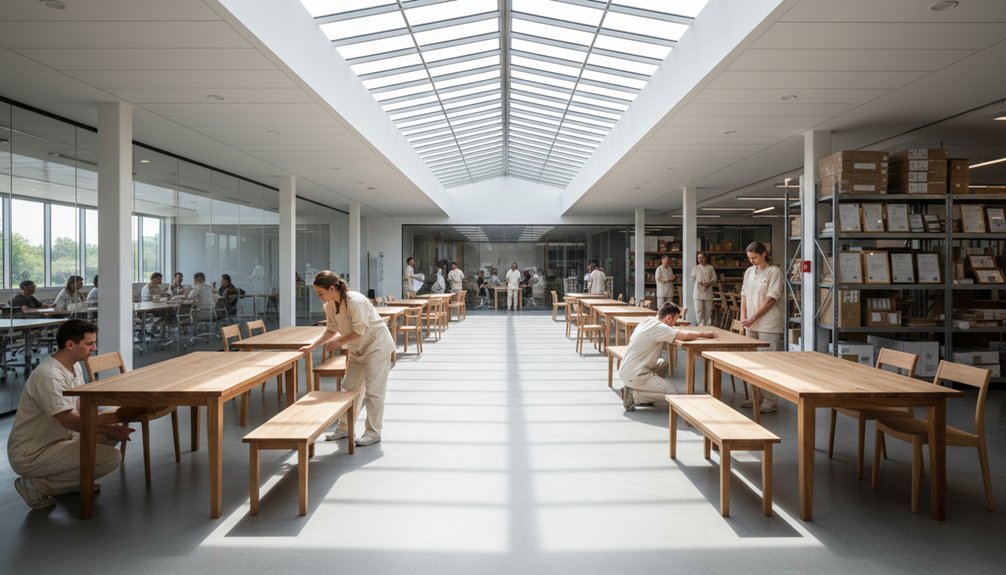
B Corp certification is crucial in furniture wholesale because it provides third-party verification of your sustainability efforts. Retailers demand proof of commitment to environmental practices and ethical sourcing from their supply chain partners. Achieving B Corp certification requires you to meet strict standards for transparency and accountability, which builds credibility with eco-conscious businesses.
This certification sets you apart from your competitors. It helps you establish stronger partnerships with retailers who share your values. By aligning with these retailers, you create an environment of mutual trust and responsibility.
Understanding the entire B Corp certification process offers additional benefits for your wholesale operations. Familiarizing yourself with the requirements can streamline your approach to sustainability and enhance your overall business strategy.
Understanding B Corp Certification in the Furniture Industry
B Corp certification changes how furniture wholesale companies conduct business and engage in social responsibility. When a company seeks this certification, it commits to stringent standards that prioritize both profit and purpose.
The certification process requires a detailed evaluation of the company’s governance, employee welfare, community engagement, environmental practices, and customer relations.
To achieve B Corp certification, a company must score at least 80 points out of 200 on the B Impact Assessment. This assessment evaluates aspects like supply chain management and employee benefits.
Companies that earn B Corp certification gain credibility with eco-conscious retailers, enhance employee retention, and connect with a network of similar businesses. Additionally, the certification mandates legal accountability, requiring companies to adjust their corporate governance to consider the interests of all stakeholders, not just shareholders.
Supply Chain Transparency and Ethical Sourcing Standards
When furniture wholesale companies pursue B Corp certification, they must achieve complete transparency in their supply chains and uphold strict ethical sourcing standards. Companies document every step of their manufacturing process, tracking raw material extraction through to final product delivery.
B Corp certification demands furniture wholesalers maintain complete supply chain transparency and document every manufacturing step from raw materials to delivery.
They monitor wood sources, verify labor conditions, and ensure fair wages for all workers in their supply chain. To comply with B Corp requirements, companies regularly audit their suppliers. They check for certifications like FSC to confirm sustainable forestry practices and maintain detailed transaction records.
The certification process mandates that companies publish annual reports that outline their supply chain impacts. B Corp evaluators closely examine vendor relationships. They assess whether companies collaborate with suppliers who align with their environmental and social values. This creates accountability throughout the entire operation, ensuring that ethical sourcing practices are consistently applied. Additionally, companies like Artisan Furniture emphasize sustainable principles in their manufacturing processes, reflecting their commitment to ethical practices.
Environmental Impact and Sustainable Manufacturing Practices
Furniture wholesalers pursuing B Corp certification must prioritize environmental responsibility in their manufacturing processes. You must implement waste reduction programs to minimize material waste generated during production.
You need to adopt energy-efficient production methods to lower energy consumption in your facilities. Additionally, you must establish water conservation systems to reduce water usage in all operations.
Sourcing eco-friendly materials is crucial for your product lines. You should focus on using reclaimed wood for furniture construction.
You must select low-VOC finishes to ensure safe indoor air quality. You also need to incorporate recycled metals and plastics into your designs to promote a circular economy.
Regularly tracking and reporting your carbon footprint is essential for transparency and accountability. You need to calculate emissions from production processes and logistics to identify reduction opportunities.
Innovative packaging solutions also play a role in your sustainability efforts. You should utilize biodegradable protective wrapping to minimize environmental impact.
You must design minimal packaging to reduce material usage and waste.
Establishing partnerships with certified sustainable forestry operations is necessary to ensure responsible sourcing of wood.
You should implement circular economy principles by designing products for longevity and recyclability. Additionally, you can take advantage of the free delivery offered by Artisan Furniture to reduce your logistical carbon footprint.
Adhering to these environmental standards is critical, as B Corp evaluators will scrutinize your practices during the certification process.
Building Stronger Retailer Partnerships Through Shared Values
As a furniture wholesale business, your commitment to environmental responsibility and social impact directly influences your relationships with retailers. When you achieve B Corp certification, you demonstrate your dedication to sustainability and ethical practices. This third-party verification helps retailers feel confident in choosing you as a partner.
Retailers actively seek suppliers who align with their values, leading to stronger and more lasting business relationships. When both your business and the retailer prioritize sustainability, collaboration becomes more effective. B Corp certification opens up opportunities for premium retail partnerships that may not be accessible otherwise. Retailers often look for suppliers who can assist them in meeting their sustainability goals, such as quality, handmade furniture that adheres to responsible production standards. This creates a mutually beneficial relationship that goes beyond simple transactions, as both parties work towards shared objectives.
Competitive Advantages of B Corp Status in Wholesale Markets
B Corp certification provides real benefits for your furniture wholesale business. This certification allows you to connect with retailers who prioritize sustainable partnerships and ethical sourcing. Retailers increasingly look for suppliers that share their commitment to environmental and social responsibility.
Your B Corp status proves your accountability through verified performance standards, which adds credibility that typical certifications lack.
With verified impact, you can differentiate your business in the market. Consumers are shifting their preferences toward brands with genuine sustainability practices. Retailers seek wholesale partners who can help them meet these consumer expectations.
Additionally, B Corp status helps you attract skilled talent who want to work for companies with a purpose. This combination of verified accountability, shared values, and talent attraction gives your business a strong competitive edge in the furniture wholesale market.
Measuring Success Beyond Financial Metrics
While profit is crucial for our furniture wholesale business, obtaining B Corp certification pushes us to evaluate our performance in several key areas beyond just financials.
We measure our environmental impact by tracking carbon emissions, waste reduction, and sustainable sourcing practices. We gather data on social responsibility by assessing employee satisfaction, community investments, and diversity within our supplier network.
We also analyze our governance practices, focusing on transparency in decision-making and accountability at the board level. This measurement system helps us pinpoint areas for improvement while showcasing our commitment to ethical leadership to stakeholders.
The B Corp impact assessment evaluates our business model, operations, and results in five main areas: governance, workers, community, environment, and customers. By reviewing these metrics quarterly, we establish a data-driven strategy for sustainability.
Quarterly B Corp assessments across governance, workers, community, environment, and customers drive our data-driven sustainability strategy.
This approach strengthens our relationships with environmentally conscious retailers and gives us a competitive edge in the wholesale market. Additionally, partnering with dropshipping suppliers allows us to enhance our product offerings while maintaining our commitment to ethical practices.