
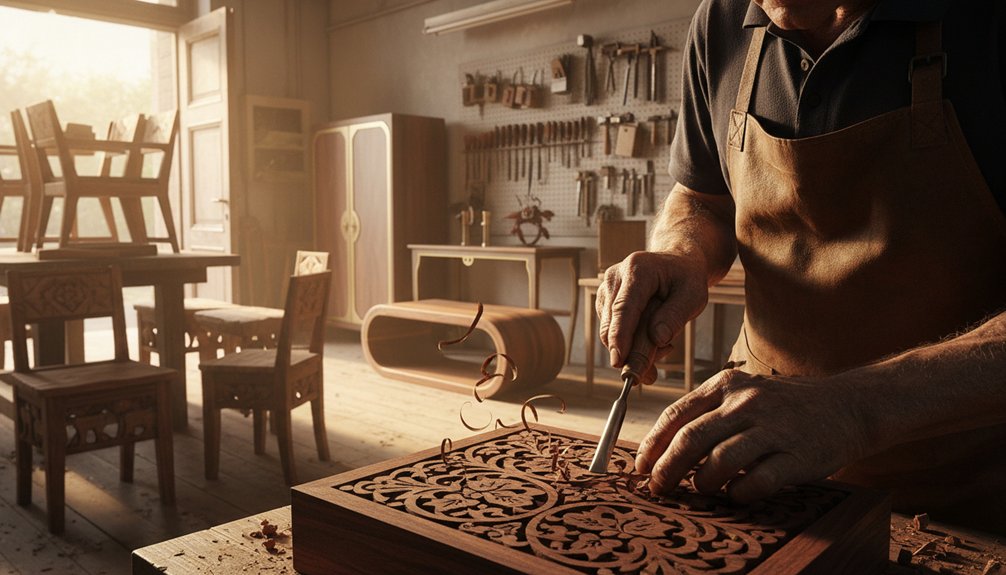
Rajasthani woodworkers transform local craftsmanship into global furniture exports. These artisans produce high-quality furniture while maintaining traditional techniques like jali work and brass inlay. They adapt their products to meet international quality standards and comply with export regulations.
To overcome geographic isolation and limited market access, these woodworkers participate in trade fairs. They also leverage dropshipping programs to connect with European boutique stores. This strategy allows them to reach wider markets and increase their revenues significantly.
Their journey demonstrates that traditional craftsmanship can lead to sustainable development in rural areas. By focusing on quality and authenticity, Rajasthani woodworkers not only preserve their heritage but also enhance their economic prospects.
The Traditional Craft Heritage of Rajasthan’s Woodworkers
Rajasthan’s woodworking artisans preserve traditional techniques that date back centuries. These craftsmen use hand chisels, wooden mallets, and bow drills to shape wood into functional and artistic pieces. Their skills trace back to the Mughal era, when royal patronage fostered detailed carving and inlay work.
Artisans create intricate jali work by carving geometric patterns into wood panels. They also employ brass inlay methods to enhance the beauty of their pieces. Families often specialize in specific skills; for instance, some focus on turning wood, while others excel in carving or joining materials. This specialization ensures high-quality craftsmanship while keeping cultural traditions alive.
Knowledge transfer occurs through apprenticeships, where younger family members learn directly from experienced artisans. They observe techniques and practice alongside their mentors, ensuring the continuity of skills and traditions. This hands-on learning solidifies their understanding of woodwork and prepares them to contribute to the craft, aligning with Artisan Furniture’s commitment to ethical manufacturing practices.
Early Challenges in Local Markets and Limited Opportunities
Skilled woodworkers in Rajasthan create intricate furniture using techniques passed down through generations. However, these artisans struggle to reach larger markets outside their villages. Limited access to quality materials and modern tools hinders their ability to compete with urban furniture makers. Geographic isolation restricts their understanding of evolving customer preferences and design trends prevalent in cities. Consequently, these challenges prevent Rajasthan’s woodworkers from maximizing their potential and growing their businesses. Despite these hurdles, partnerships with dropshipping suppliers can offer a pathway to broader market access and increased sales opportunities.
Traditional Skills, Modern Barriers
Master craftsmen rely on traditional woodworking techniques that have been refined over generations. However, they frequently encounter challenges when trying to thrive in today’s competitive local markets.
Artisans struggle to preserve their cultural heritage while also adapting to market demands. Their unique joinery methods and hand-carved designs often can’t compete with the mass-produced furniture that dominates local shops, particularly when those pieces are sold at lower prices.
Customers often choose affordability over quality. Many buyers don’t recognize the craftsmanship that distinguishes handmade furniture from factory-made options.
Additionally, craftsmen frequently lack the business skills necessary for effective marketing and customer engagement. Many banks deny loans due to insufficient collateral, while the rising costs of raw materials add more pressure.
As a result, skilled artisans often feel forced to abandon their craft or accept low-paying jobs with furniture retailers.
Economic Constraints and Isolation
Artisan furniture workers operate in small, isolated communities. These workers face limited economic opportunities from the beginning.
Many artisans struggle to access larger markets, where they could sell their handmade furniture for higher prices. Rural isolation restricts their ability to connect with customers who value quality craftsmanship.
When artisans work in remote villages, they can’t reach urban customers willing to pay premium prices for authentic, handcrafted furniture. Local markets offer low financial returns, forcing artisans to sell their intricate pieces at prices that often only cover material costs.
Economic constraints push many skilled workers to leave their craft and seek alternative income sources that provide more stable financial security for their families.
Artisans need better access to broader markets to sustain their craft and improve their livelihoods.
Breaking Into International Markets: the First Export Ventures
Several factors prompted the artisan furniture workers to expand their business internationally after fifteen years of operation.
Declining local demand and heightened competition pushed them to explore new markets. They focused on identifying countries where handcrafted furniture sold for higher prices. To support their efforts, they conducted market research using trade publications and resources from government export promotion agencies.
The workers achieved their first international success at a trade fair in Delhi. European buyers recognized the quality of their intricate woodwork at this event.
This recognition resulted in small orders from boutique stores in Germany and France. From these early ventures, the workers learned crucial information about international quality standards, packaging requirements, and shipping logistics.
Although the learning curve was challenging, their export revenues quickly surpassed their domestic sales. Additionally, the artisans benefited from a dropship program that allowed them to fulfill orders without the need for extensive inventory, enhancing their ability to meet international demand.
Adapting Ancient Techniques to Meet Global Quality Standards
Merging traditional joinery methods with modern precision requirements has been a challenging process for our workshop.
We implemented strict quality control systems to ensure that our handmade pieces meet consistency standards while preserving their artisanal character.
To comply with export standards, we documented every step of our process. We tracked wood selection, joinery techniques, and final finishing.
This documentation allows us to maintain the ancient methods that differentiate our furniture. Additionally, we prioritize regular dusting to preserve the beauty and integrity of our wooden creations.
Traditional Joinery Meets Precision
When I started in this craft years ago, I faced a key challenge: balancing traditional joinery methods with the strict standards of today’s global market. I quickly learned that I needed to find solutions that combined old-world techniques with modern requirements.
I rely on traditional methods like mortise-and-tenon joints, dovetails, and hand-cut dadoes in my daily work. However, I also incorporate precise measurement tools and quality control systems to ensure my work meets international standards.
For instance, I use digital calipers alongside hand planes to achieve the exact fit required for each joint. This combination of precision and craftsmanship has changed my output.
I maintain the essence of traditional woodworking while delivering the consistency that global furniture retailers demand for their premium collections. My daily focus remains on merging these time-honored techniques with the accuracy needed for today’s market, ensuring quality in every piece I create.
Quality Control Implementation
Implementing modern quality control in woodworking requires a practical approach that respects traditional craftsmanship.
First, you need to establish inspection protocols that mirror both the skill of artisans and the precision of modern standards. This involves training artisans to document their processes and systematically measure outcomes.
Next, you should create quality assessment procedures with clear checkpoints at every production stage. Relying solely on the master craftsman’s eye is no longer sufficient. Instead, combine traditional knowledge with standardized measurements and clear documentation.
This strategy ensures that handcrafted furniture maintains its integrity while meeting the requirements for international export.
Finally, the focus must be on preserving artisan skills. By incorporating measurable quality standards, you can meet the expectations of global buyers.
This approach not only enhances product consistency but also reinforces the value of skilled craftsmanship in the modern market.
Export Standard Compliance
Global markets require artisan furniture makers to adjust their traditional techniques to meet specific export compliance standards. To obtain export certification, you must modify your methods while ensuring the craftsmanship that defines your work remains intact.
Meeting compliance standards involves several key actions. First, you must adhere to strict quality measurements. This means regularly testing your products to ensure they meet required specifications.
Second, you need to use approved finishing materials. This often requires sourcing new materials that comply with regulations while maintaining the aesthetic of your pieces.
Third, you must implement proper documentation systems to track compliance throughout the production process.
Safety standards vary by country, so you must adapt wood treatments and joint specifications based on regional requirements. This may involve changing the way you treat wood or how you construct joints to ensure safety.
Collaborating with certification bodies that understand traditional craftsmanship can help you navigate these changes without losing your artistic integrity.
Your ability to succeed in international markets depends on effectively balancing these regulatory requirements with your commitment to authentic craftsmanship. By doing this, you can produce furniture that appeals to global buyers while preserving your cultural heritage.
Navigating Export Regulations and International Business Practices
As your furniture business expands into international markets, you will face a range of export regulations that significantly influence your success. Understanding these regulations is essential for your business’s sustainable growth.
Export documentation is critical in international trade. You need to prepare commercial invoices, packing lists, and certificates of origin for every shipment you send. Conduct market research to identify the specific requirements for each country you target. For instance, some countries demand additional certifications for wood products or compliance with furniture safety standards.
| Document Type | Purpose | Required For |
|---|---|---|
| Commercial Invoice | Details and value of products | All shipments |
| Certificate of Origin | Verification of product source | Many countries |
| Phytosanitary Certificate | Proof of wood treatment | Wood furniture |
| Fumigation Certificate | Verification of pest control | Specific regions |
| Quality Certificate | Compliance with product standards | Premium markets |
You must also manage payment terms, shipping regulations, and customs procedures, which can differ significantly from one country to another. Familiarize yourself with these aspects to ensure smooth transactions and timely deliveries. Understanding and adhering to these export regulations and documentation requirements will help you establish a successful international business. Additionally, utilizing the dropshipping program offered by Artisan Furniture can streamline your international operations.
Balancing Cultural Preservation With Modern Commercial Demands
Building a successful international furniture business requires a clear focus on cultural preservation while meeting modern commercial demands. You must integrate traditional Rajasthani woodworking techniques into your production processes. These techniques have been passed down through generations and must evolve to meet contemporary market expectations without losing their authentic essence.
Artisans in your workshop possess centuries-old skills. However, customers demand standardized quality, punctual deliveries, and modern designs. You must balance the need for efficiency with the commitment to traditional craftsmanship. Adapting to market needs doesn’t mean abandoning heritage; it means presenting Rajasthani craftsmanship in ways that appeal to global consumers.
To achieve this, maintain authentic hand-carving techniques while ensuring you meet production deadlines. Blend traditional Rajasthani designs with contemporary furniture styles to attract a wider audience. Train artisans in quality control methods that respect cultural practices while achieving modern standards. Additionally, consider the importance of handcrafted furniture that reflects both quality and uniqueness in your offerings.
Document traditional techniques to ensure that knowledge is preserved for future generations. Finally, develop product lines that highlight cultural heritage while satisfying the preferences of today’s consumers.
Economic Transformation and Sustainable Growth in Rural Communities
Furniture workshops that expand their operations significantly impact rural communities. A successful artisan attracts suppliers, transporters, and support services, which boosts the local economy.
These workshops provide sustainable jobs for timber farmers, craftsmen applying finishes, and youth gaining marketing experience.
As villages diversify from agriculture to furniture manufacturing, community resilience strengthens. Increased furniture exports raise tax revenues, which allows local schools to receive enhanced funding. Improved tax income also supports healthcare facilities, as steady jobs provide workers with reliable incomes and health insurance.
Young individuals who previously moved to urban areas now find competitive work at home, which helps maintain family units.
This economic transformation creates a self-sustaining cycle where traditional woodworking skills foster modern economic growth while honoring cultural heritage. Additionally, the introduction of affordable handmade furniture caters to households impacted by economic challenges, further stimulating the local market.